Default
Video sessions
Secure Google Meet, camera-on by default but never required. Most clients land here.
Culture
This is a neurodivergent-affirming, relational practice. Sessions are designed to meet sensory, attentional, and emotional needs, not to override them.
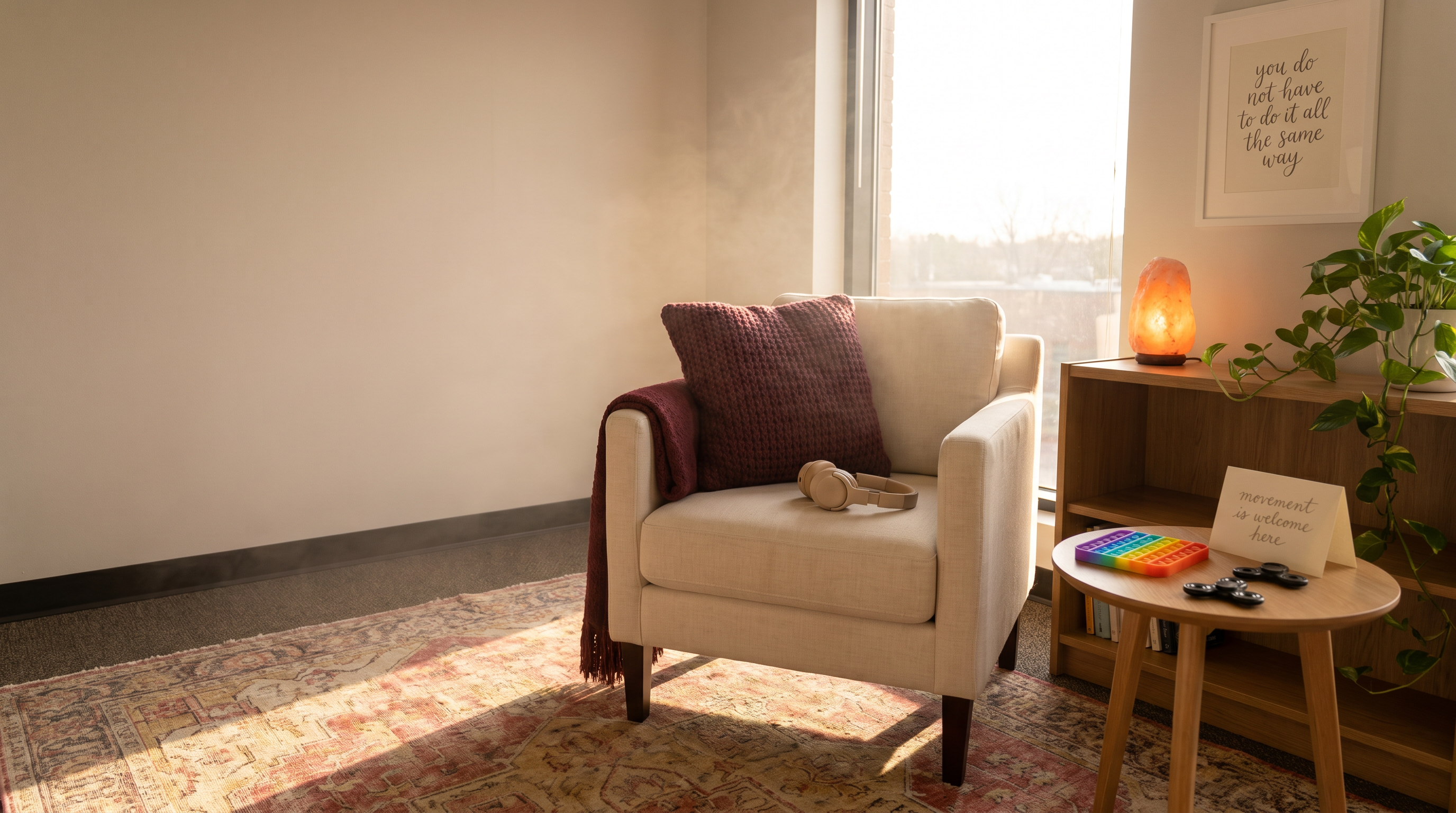
How the room is held
The culture of this practice is collaborative, direct, and deeply human. Sessions are not passive listening only. There is room for emotional spaciousness, silence, and nonlinear process, and there is also room for clear reflection, clinical naming, pattern recognition, and active feedback when that supports the work.
I welcome feedback from clients about what is landing, what is not, what feels too fast, what feels too vague, and what kind of support helps you stay connected to yourself. The goal is not performance. The goal is a therapeutic relationship sturdy enough to hold honesty in both directions.
This is a small, relational practice, not a high-volume, rapid-response one. I take in roughly one to two new clients per quarter, on purpose, so the work stays depth-oriented and the caseload stays small enough to actually hold.
I do not structure the practice around urgency, and I do not ask clients to either. The email response system is tiered: standard messages in 3–5 business days, action-required in 2–3, urgent in 1–2. Different things deserve different timeframes. The assumption that everything must be immediately responsive is part of what wears people down in the first place.
Scheduling Note: To accommodate the fluid nature of therapy, please allow for a 5-minute delay at the start of our sessions and up to 10 minutes of buffer space afterward. This ensures we don't overlap with other commitments if a session needs a few extra moments to wrap up naturally.
It means the small adjustments people often have to ask for, and sometimes mask through, are built in from the start. You don't have to perform a particular kind of attention to be in this work.
For sensory reasons, low-bandwidth days, or moments when being on camera is genuinely too much, audio-only sessions are available on request. The clinical work doesn't suffer. Often, something harder to say in a face-to-face session gets said when the camera is off.
This practice works with adults across the full adult lifespan. That includes:
Cross-generational care isn't a marketing line here. It's the actual mix of the practice. Different generations carry different language, different reference points, and different relationships to therapy. The work adjusts.

You're welcome to name accommodations in the consultation call, in our first session, or any time after. There is no exhaustive list you need to come in knowing. The goal is to build the room together.

Email the practice ahead of time. If it's something we can build into how sessions run, we will.
Formats & contact
Video is the default, but it isn't the only door. If your nervous system is steadier on the phone, or you need to lie down with the lights off and just talk. Those are real options here.
Default
Secure Google Meet, camera-on by default but never required. Most clients land here.
On request
Same platform, camera off. Useful when seeing yourself on screen is its own kind of overwhelm.
On request
A real phone call. No app, no screen, no link to click. For clients who do their best thinking with eyes closed, walking slowly, or simply away from a device.
Check-in phone call
$20 / up to 25 mins check-in phone call. A brief, focused call for established clients facing something time-sensitive between sessions. Availability is not guaranteed and this is not a crisis service. For crises, use 988, Crisis Text Line, 911, or the nearest emergency department.
Non-urgent administrative response
Email is not an emergency channel. For crises, call or text 988, text HOME to 741741, call 911, or go to the nearest emergency department. NAMI HelpLine: 1-800-950-6264 for non-emergency support and information.
The consultation is itself low-pressure. A 20-minute phone call, no video required.
Book a consultation